 Post by
 AI has moved far beyond being something we only associate with chatbots and futuristic technology.
Today, businesses are using AI to answer customer questions, qualify leads, process documents, automate repetitive tasks, analyze information, and even assist employees with everyday decisions.
But here’s the important part: you don’t need to become an AI company to benefit from AI.
Whether you’re running a retail business, managing a growing enterprise, operating a service company, or building a digital-first business, there are probably processes in your organization that could be faster, smarter, and easier with the right automation.
That’s where AI automation for business comes in.
Instead of asking employees to repeatedly perform the same tasks, businesses can use AI-powered systems to handle parts of these workflows automatically—while keeping people involved where human judgment actually matters.
What Is AI Automation for Business?
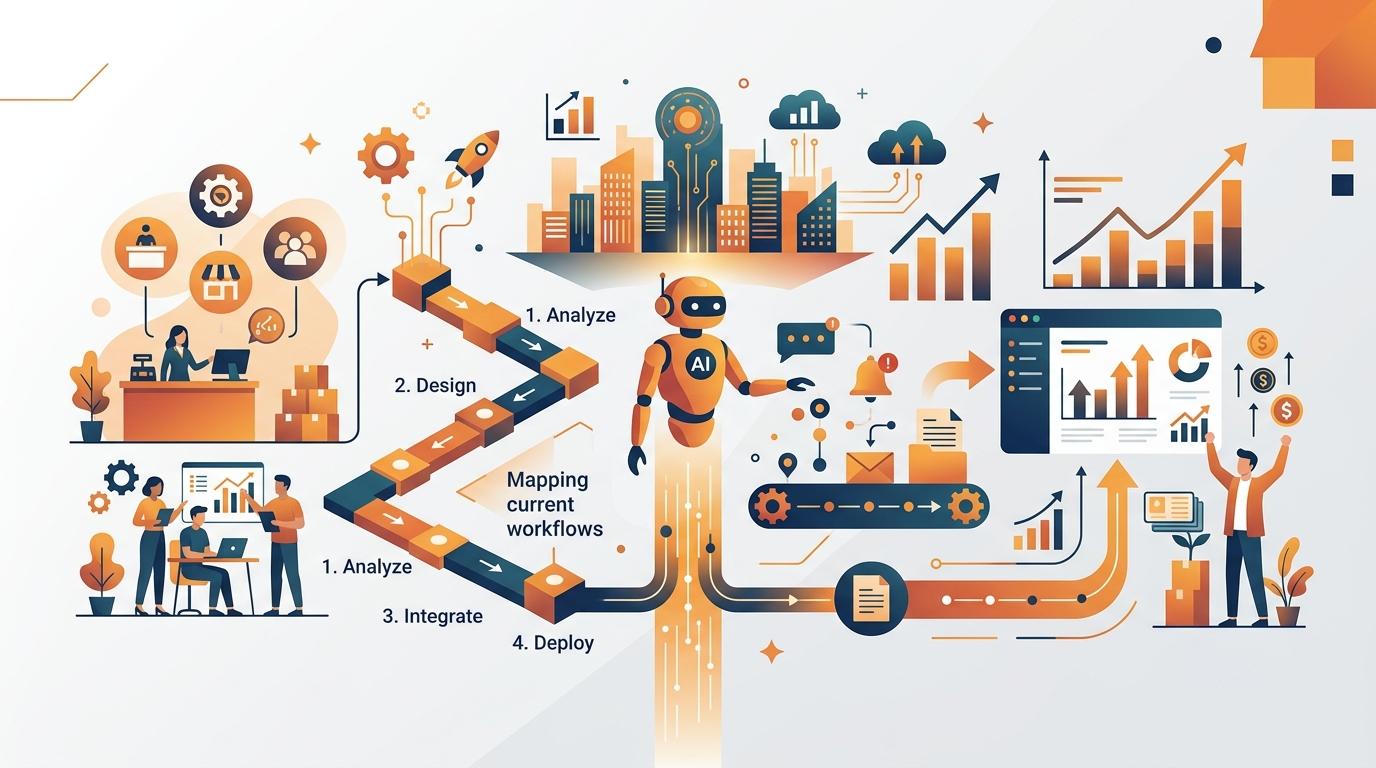
In simple terms, AI automation combines artificial intelligence with business workflows to get things done with less manual effort.
Traditional automation usually works with fixed instructions. For example:
When a customer submits a form → send an email.
AI automation can be a little more flexible. For example:
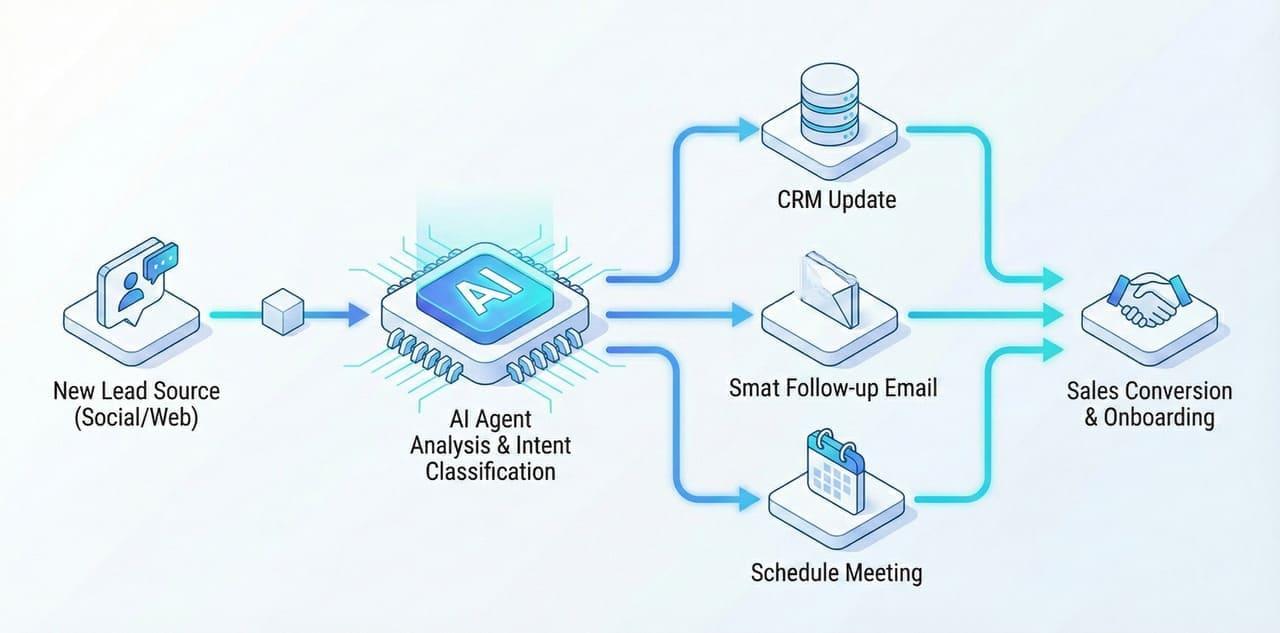
Customer submits an inquiry → AI understands the request → identifies what the customer needs → checks relevant information → responds → updates the CRM → alerts the sales team if necessary.
The difference is important.
AI doesn’t just follow a predefined instruction. Depending on the system and use case, it can interpret information, recognize patterns, generate responses, and help determine what should happen next.
That’s why businesses are increasingly looking at intelligent automation as a way to improve how their teams work.
Why Are Businesses Investing in AI Automation?
Let’s be honest-most businesses don’t adopt new technology simply because it’s interesting.
They adopt it because something needs to improve.
Maybe employees are spending too much time entering data. Maybe customer inquiries are piling up. Maybe sales teams aren’t following up quickly enough. Or perhaps managers are waiting until the end of the week to get information that they needed yesterday.
These are the kinds of problems AI automation can help address.
According to McKinsey’s 2026 research, nearly nine in ten organizations report regular AI use in at least one business function. However, the organizations seeing the greatest value are going beyond simply experimenting with AI and are integrating it into their workflows and operating models.
In other words, using AI and getting business value from AI are two different things.
The real opportunity is connecting AI to the way your business already works.

7 Benefits of AI Automation for Business
1. Less Repetitive Work
Think about the tasks your employees do every single day.
Copying information from one system to another. Answering the same questions. Creating routine reports. Sorting documents. Sending follow-up emails.
None of these tasks necessarily require someone’s full attention.
AI automation can take care of many repetitive activities, allowing your team to spend more time on work that actually requires their expertise.
The goal isn’t to make people work less. It’s to help them spend more time doing meaningful work.
2. Faster Operations
A business process can slow down when it depends on several people completing several small steps.
For example:
Lead received → employee reviews lead → lead entered into CRM → sales representative notified → follow-up sent
With automation, much of this can happen automatically.
Lead received → AI qualifies lead → CRM updated → sales team notified → follow-up initiated
The result is a smoother process with fewer delays.
3. Better Customer Support
Customers don’t always contact businesses between 9 AM and 5 PM.
They may have a question at night, need an order update on the weekend, or simply want an immediate answer.
An AI chatbot or virtual assistant can handle common questions at any time.
It can help with:
- FAQs
- Order information
- Appointment booking
- Product information
- Lead collection
- Service inquiries
- Basic troubleshooting
And when a question requires a human, the system can hand it over to the appropriate team member.
So instead of replacing your support team, AI can help them focus on the conversations that matter most.
4. Fewer Human Errors
Manual data handling creates opportunities for mistakes.
A number gets entered incorrectly. A customer record isn’t updated. An invoice is sent to the wrong person.
These small errors can create bigger problems later.
Automated workflows help standardize repetitive processes and reduce unnecessary manual data entry.
5. Better Customer Experiences
Customers expect businesses to understand their needs.
AI can help create more personalized interactions by using information from previous conversations, purchases, preferences, or customer profiles.
For example, instead of giving every customer the same generic response, an AI-powered system can use available context to provide a more relevant answer.
That’s a much better experience.
6. Lower Operational Costs
One of the biggest advantages of automation is the ability to handle more work without continuously adding more manual processes.
A business might be able to process more customer inquiries, invoices, orders, or leads using the same team.
The real value isn’t simply cutting costs.
It’s getting more value from the resources you already have.
7. Faster Access to Business Insights
Businesses generate enormous amounts of information every day.
Sales data. Customer data. Inventory data. Website data. Financial information.
The challenge isn’t always collecting the data.
It’s understanding it quickly enough to make decisions.
AI-powered reporting and analytics can help identify patterns, summarize information, and highlight areas that deserve attention.
8 Real-World AI Automation Use Cases
AI Chatbots
One of the easiest ways businesses can start using AI is through customer-facing chatbots.
An AI chatbot can answer common questions, collect customer details, recommend services, and route conversations to the right person.
For businesses receiving a high volume of similar inquiries, this can make a noticeable difference.
AI Lead Qualification
Not every lead deserves the same sales effort.
AI can analyze incoming inquiries and identify which leads appear more relevant based on factors such as requirements, industry, budget, location, or buying intent.
The sales team can then focus their attention where it’s most likely to produce results.
CRM Automation
Salespeople shouldn’t have to spend half their day maintaining the CRM.
AI can help summarize conversations, identify follow-up actions, categorize leads, and update customer information.
This keeps the CRM useful without turning it into an administrative burden.
Document Processing
Businesses deal with documents constantly.
Invoices, purchase orders, applications, contracts, forms, and reports all contain information that often has to be manually reviewed.
AI-powered document processing can extract important information and send it into the appropriate workflow.
For example:
Invoice received → information extracted → details verified → approval requested → accounting system updated
That’s a lot of manual work removed from a simple process.
Employee AI Assistants
Imagine an employee asking:
“What’s our leave policy?”
Instead of searching through folders or asking HR, an internal AI assistant could provide the answer based on approved company information.
The same concept can be applied to internal documentation, processes, product information, and company knowledge.
Marketing Automation
AI can help marketing teams understand audiences, personalize communication, analyze campaigns, and automate repetitive activities.
This doesn’t mean handing your entire marketing strategy to AI.
It means giving marketers better tools to work faster and make more informed decisions.
Inventory Automation
For retailers, distributors, and other inventory-driven businesses, AI can help identify purchasing patterns, stock issues, and demand trends.
Combined with ERP or inventory management systems, automation can help businesses respond before a problem becomes expensive.
Automated Reporting
Managers often spend too much time waiting for information—or collecting it manually.
AI-powered reporting can bring information together from different systems and turn it into easier-to-understand summaries.
Instead of spending hours preparing a report, your team can spend that time actually using the information.
Frequently Asked Questions
What is AI automation for business?
AI automation uses artificial intelligence to perform or assist with repetitive tasks, workflows, customer interactions, data processing, and business processes that traditionally require manual effort.
How can AI automation improve business productivity?
It can reduce repetitive work, speed up workflows, minimize manual errors, and help employees spend more time on strategic and customer-focused activities.
What businesses can benefit from AI automation?
Almost any business can benefit from AI automation if it has repetitive, data-heavy, or time-consuming processes. Common industries include retail, healthcare, logistics, finance, real estate, manufacturing, and professional services.
Can AI automation integrate with ERP and CRM software?
Yes. AI can be integrated with ERP, CRM, databases, websites, APIs, accounting platforms, and other business systems to create connected workflows.
What is an AI chatbot?
An AI chatbot is a software system that uses artificial intelligence to communicate with users, answer questions, provide information, collect leads, and assist with customer support.
What are AI agents?
AI agents are AI-powered systems designed to complete multi-step tasks using connected tools and systems while operating within defined permissions and controls.
Is AI automation suitable for small businesses?
Yes. Small businesses can start with focused automation such as customer support, lead qualification, appointment scheduling, reporting, and document processing.
How much does AI automation cost?
The cost depends on the complexity of the automation, AI model requirements, integrations, data, infrastructure, security, and number of workflows involved. A focused automation project will generally require less investment than a large enterprise AI platform.
Can AI completely replace employees?
AI is better viewed as a tool that helps employees work more efficiently. Many business processes still require human judgment, creativity, accountability, and decision-making.
How can I get started with AI automation?
Start by identifying a repetitive or time-consuming business process. Then assess whether AI or traditional automation can improve it, define measurable goals, and work with an experienced AI development partner to implement the solution.
How Scanntek Helps Businesses Implement AI Automation
At Scanntek, we don’t believe AI should be added to a business just for the sake of having AI.
We start by understanding how your business works, where your teams spend time, and where technology can make a real difference.
Our AI & Intelligent Automation solutions can help businesses build and integrate:
- AI Chatbots
- AI Virtual Assistants
- Business Process Automation
- Workflow Automation
- AI Lead Qualification
- CRM Automation
- ERP & AI Integration
- Document Processing
- AI-Powered Reporting
- Intelligent Business
- Applications
Whether you’re looking to automate one repetitive workflow or build a more connected AI-powered system, we can help you identify the right approach.